There are grains that cook, and grains that work. Bomba rice belongs to the second category. Grown in the irrigated huertas of Calasparra, in Murcia, under the protection of a PDO that governs every stage of its production, this short japonica variety rice is the object of an attention that few ingredients receive in Spanish cooking. Not because it is rare in the luxurious sense of the word, but because it is precise.
What the structure of a grain changes about everything
Bomba rice owes its cooking behaviour to an anatomical particularity: its starch cells absorb the liquid gradually, from the outside in, without disintegrating. Where an arborio rice — designed for the creaminess of risotto — releases its starch into the broth and binds together, the Bomba holds its shape. Where a jasmine or a basmati, also well structured, absorb quickly and stay firm, they have neither the absorption capacity nor the thermal tolerance needed to withstand the twenty minutes of direct cooking in a concentrated sofrito, over high heat, uncovered.
Bomba absorbs up to three times its volume in liquid. This figure is not a commercial promise: it is the result of varietal selection carried out over decades in the valleys of the Segura and the Mundo, where the water arrives cold from the mountains and slows the growth of the grain, densifying its texture. A grain that is slower to ripen is a more compact grain. A compact grain resists the dry heat of the paellera better.
Comparing Bomba to its usual equivalents helps to understand what is lost when they are substituted:
- Arborio releases its starch on the surface and creams the broth — a desired effect for risotto, fatal for a paella that must remain grain by grain.
- Basmati elongates during cooking and stays dry — it will not catch the socarrat, that golden crust at the bottom of the paellera.
- Jasmine rice is too sticky as soon as it absorbs a fatty, fragrant broth — it forms a mass rather than a layer.
Calasparra rice is the only Spanish rice to have obtained a designation of origin even before this concept was formalised in European law.Ministerio de Agricultura, Pesca y Alimentación, Madrid
Side by side
Four rices in the paellera
Tap a card: why Bomba, and not another.
Short history, long roots
Rice cultivation in the Valencia region dates back to the Arabs, who shaped the irrigation systems of the Albufera between the 8th and the 12th century. But Bomba rice as we know it today — selected, stabilised, grown at altitude in the gorges of the Segura — emerged at the end of the 19th century as a response to an agronomic constraint: the lands of Calasparra, colder and less productive than the Albufera, compelled farmers to work with varieties that tolerate a longer growing cycle. This mild climatic stress produces a more nervous, more resistant grain. The first local regulation dates from 1918. The European PDO, which came later, simply confirmed what Valencian cooks had long known.
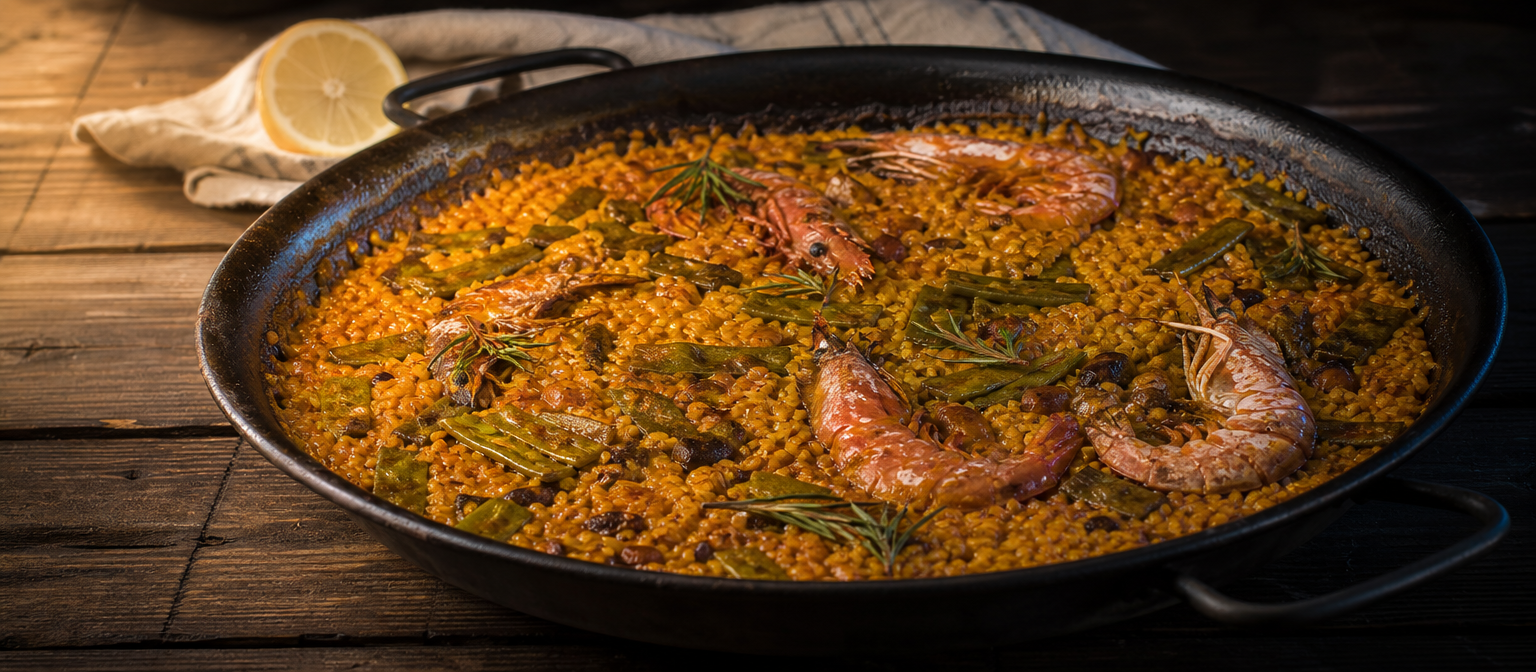
It should be noted that the word "paella" originally refers to the vessel — the flat pan with two handles — and not to the dish. Traditional Valencian paella (chicken, rabbit, beans, rosemary) has little to do with the touristy seafood versions. What all versions share is the demand made on the rice: a thin layer in the vessel, never stirred after the broth is added, cooked uncovered to allow the controlled evaporation that concentrates the flavours in the grain.
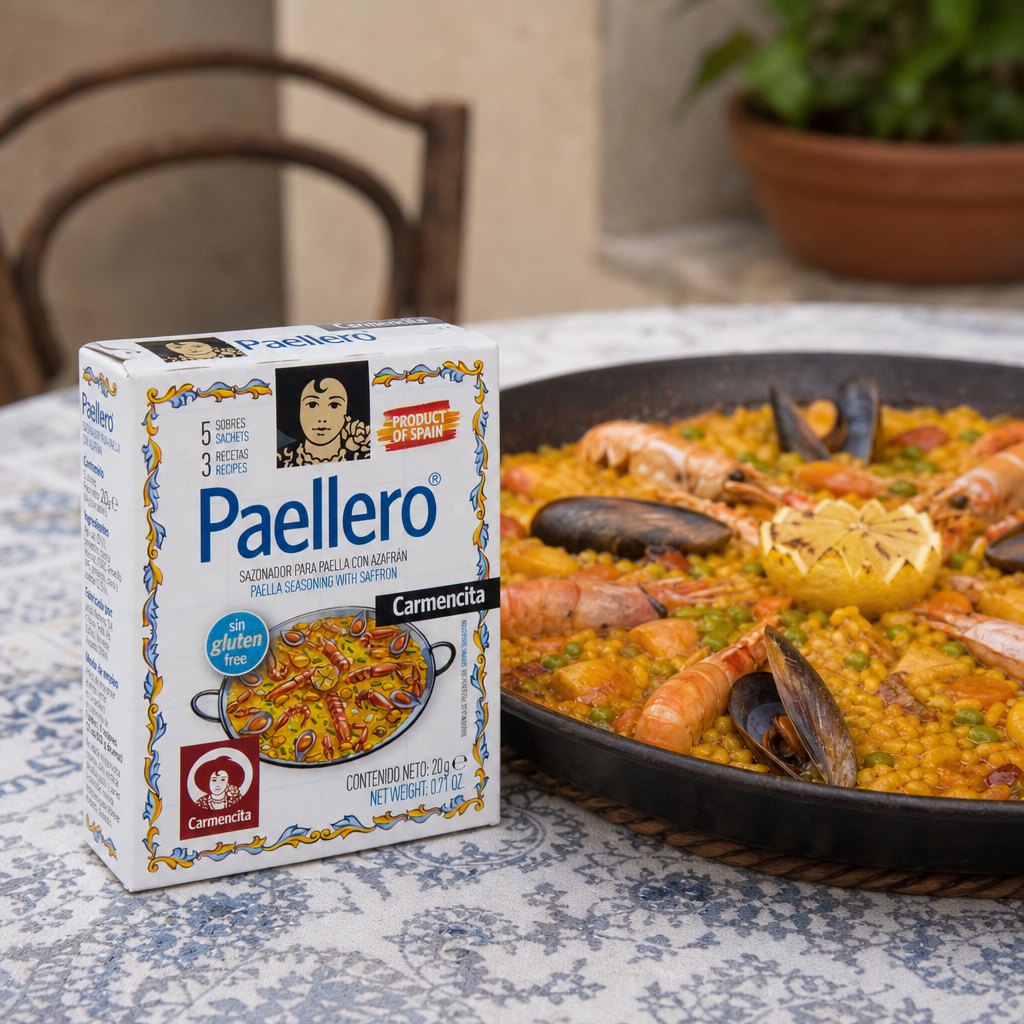
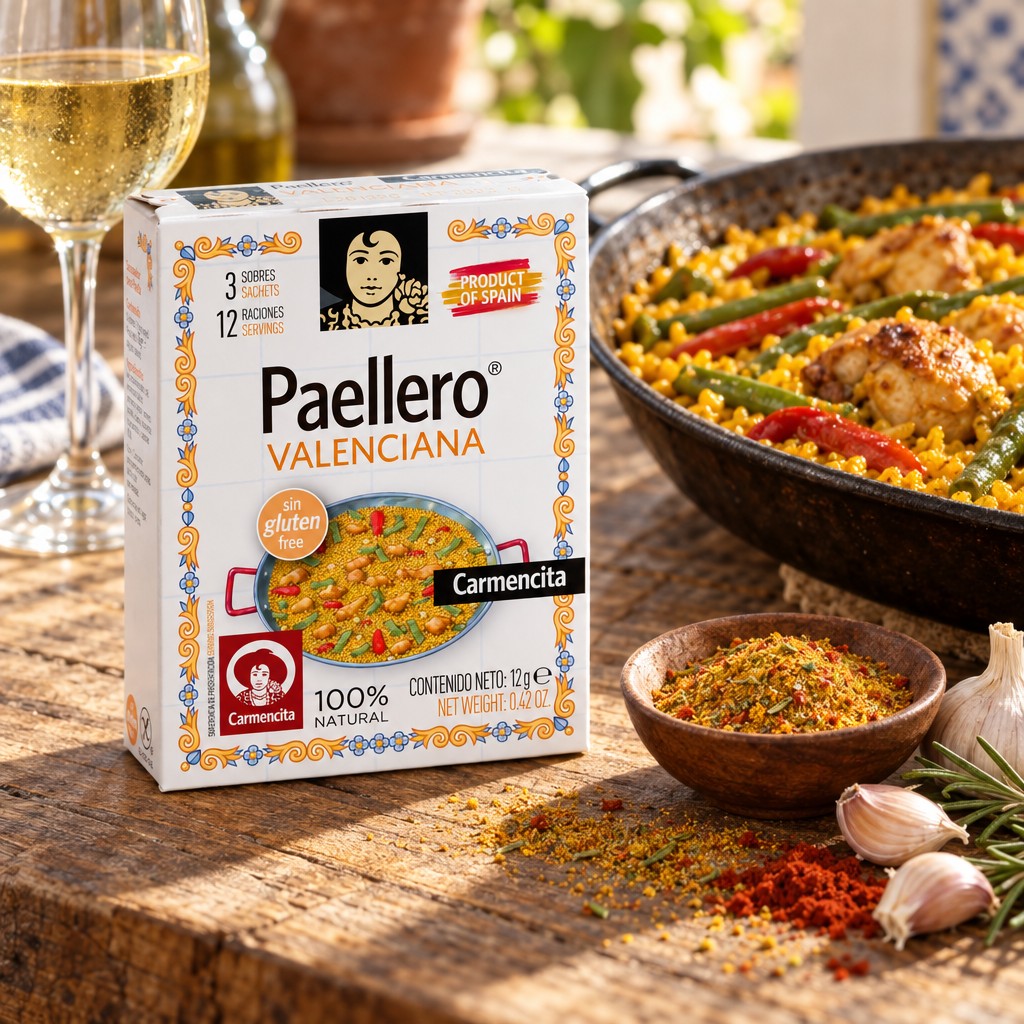
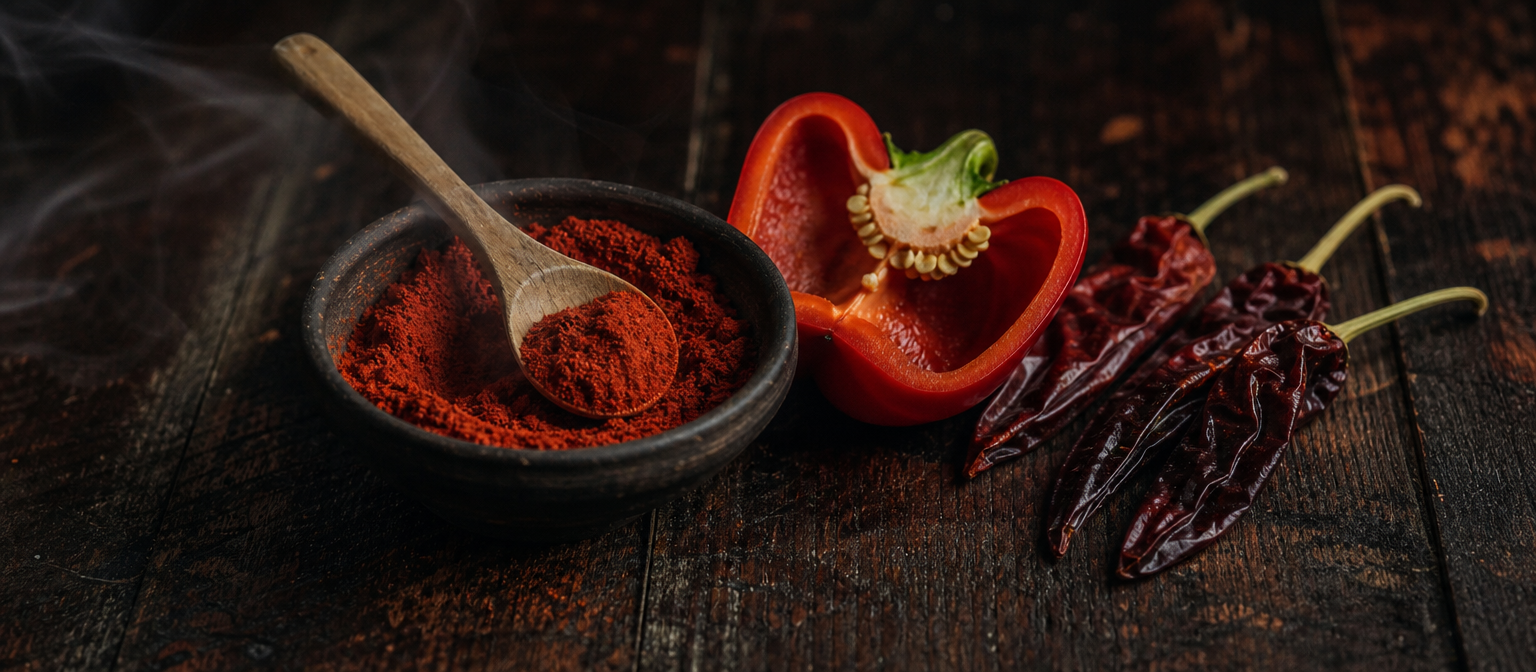
At Orígenes, to season the paella, we offer spices from Carmencita, a Spanish house from Novelda (Alicante), founded in 1923, whose flagship product is the Paellero, a spice blend with saffron.
For a paella for four, allow 350 g of Bomba and one litre of cold poultry broth poured all at once over the hot sofrito. The temperature difference creates a shock that makes the grain swell quickly on the surface while preserving its core. Do not stir after this moment. Let the heat ease off over eighteen minutes. The final three minutes over high heat give the socarrat — listen for the rice crackling slightly, that's the signal.
Calculator
Rice and stock for your table
Hector's amounts for four, scaled to your number of guests.
| Bomba rice | 350 g |
| Cold chicken stock | 1 L |
Quantities from this article's recipe, scaled to your table.
How to cook it, and how to ruin it
The main mistake with Bomba rice is not overcooking it — it holds up well — it is underfeeding it with broth. Because it absorbs more than other rices, an insufficient proportion gives a grain cooked on the surface but floury at the centre. The basic rule: three volumes of broth to one volume of rice. Not two, contrary to what is calculated for long-grain rice.
The most frequent mistakes:
- Stirring the rice after adding the broth — this releases the starch and sticks the grains together.
- Covering the paellera — the steam prevents evaporation and drowns the socarrat.
- Using a broth that is too salty — Bomba concentrates the flavours, a well-seasoned broth becomes too intense once absorbed.
- Adding the rice to a cold sofrito — the grain must enter a hot base to start absorption immediately.
The resting time is often neglected. Two to three minutes off the heat, covered with a clean cloth (not a hermetic lid), allow the residual moisture to redistribute evenly through the grain. This is the difference between a rice that holds up on the plate and a rice that collapses.
What to remember: Bomba rice from Calasparra absorbs three times its volume in broth without falling apart, thanks to a dense cellular structure developed at altitude. It is not interchangeable with arborio, basmati or jasmine in a paella — each of these rices follows a different cooking logic. The PDO guarantees its origin and its growing conditions in Murcia. Used well, it produces a firm, fragrant grain, with a possible socarrat. Wrongly dosed with broth or stirred during cooking, it yields an ordinary result. Technique matters as much as the product.
You will find our paella rices and seasonings in our rice and cereals section, along with all the references needed for rigorous Spanish cooking. Delivery in Switzerland within 3 to 7 working days, free returns within 14 days.
Quick quiz
Have you mastered Bomba?
Four questions, the answers are in the article.