In December, turrón arrives on the table with its own vocabulary. On the box you read torta, yema tostada, suprema, IGP, sometimes imperial. These are simple words, but they are rarely explained. So people buy more or less at random and end up with three bars that all have the same texture.
Here, then, is a short glossary. Each word takes two lines. By the end, you will know what you are buying, how to cut each paste and when to serve it. You will also be able to put together a festive table where each turrón brings a different texture: crunchy, melting, creamy and soft.
Words of origin
Jijona (Xixona)
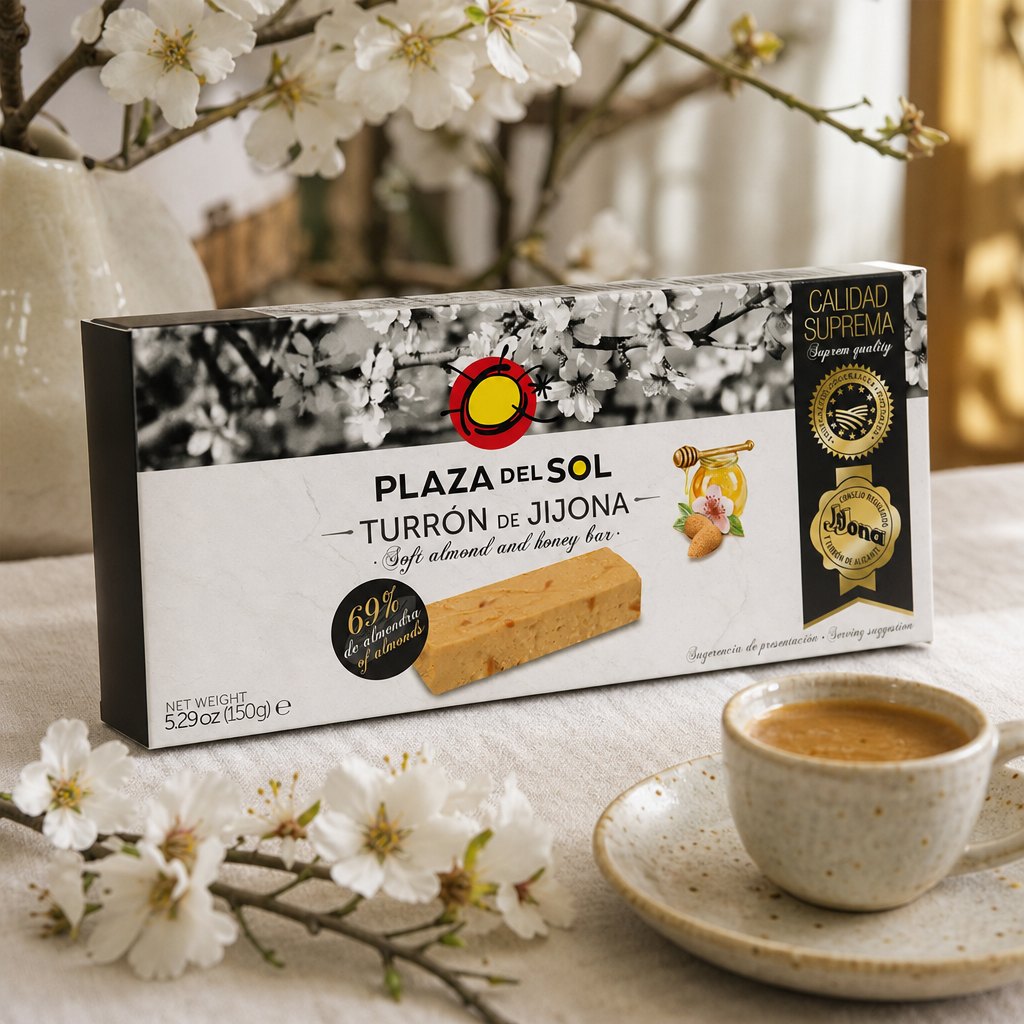
This is a village in the province of Alicante, the Spanish home of turrón. The name also refers to a paste: Jijona turrón, tender and soft.
Alicante
This is the province, and also the other great style: Alicante turrón, hard, with whole almonds set in honey. Jijona and Alicante belong to the same tradition, but they are two opposite textures.
IGP
IGP stands for Protected Geographical Indication. On a turrón, this label shows that the paste falls under a designation, with its own specification and controls.
Regulatory Council (Consejo Regulador)
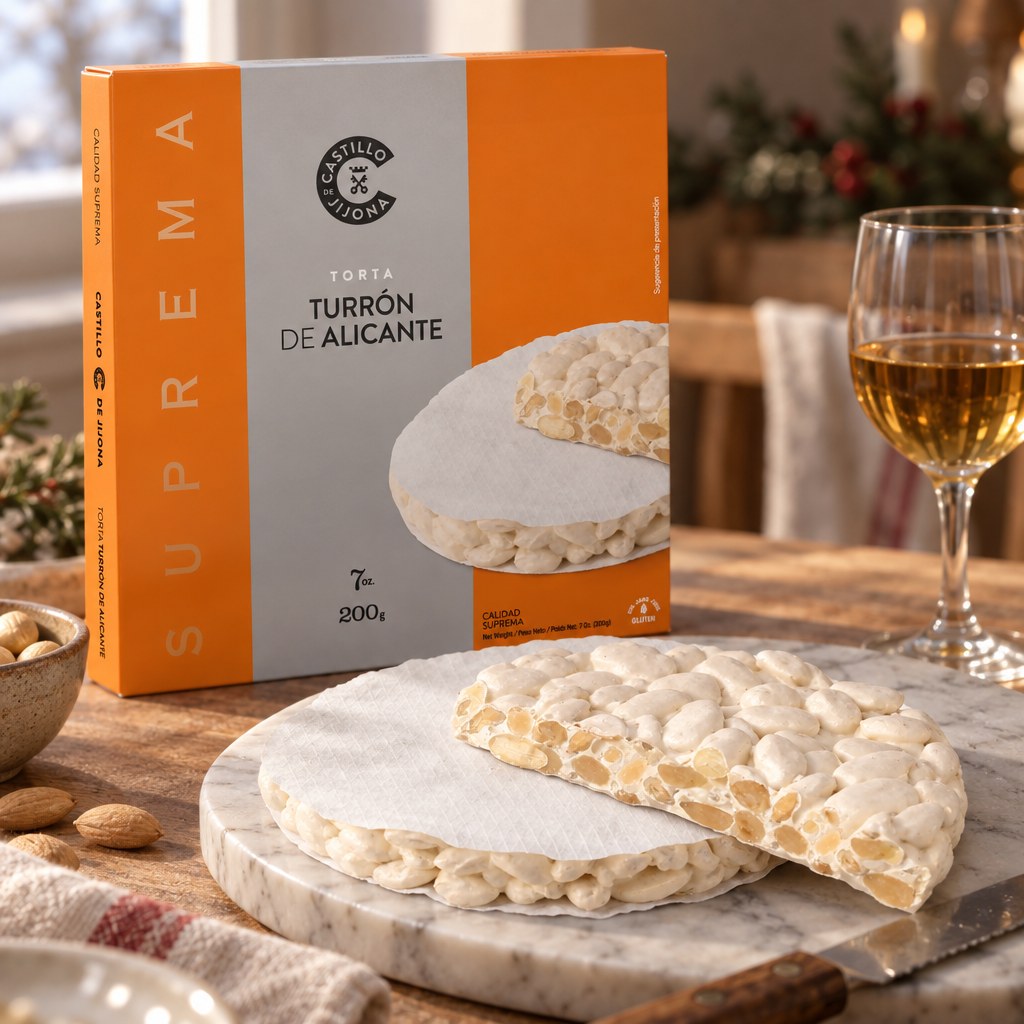
This is the body that oversees the “Jijona” and “Turrón de Alicante” IGPs. Its seal, printed on the packaging, is the mark to look for. You will find it, for example, on the Alicante turrón torta from Castillo de Jijona.
Suprema (Supreme)
This is a Regulatory Council category, printed next to the IGP seal. The Plaza del Sol Jijona turrón IGP Suprema, for example, states 69% toasted almonds in its list of ingredients.
Extra
This is another category designation you will come across on boxes. Rather than comparing the words with one another, compare the percentage of almonds: when it is given, it tells you more than the word does.
On the packaging
Six words worth recognising
Tap a card: what the word tells you, and what it does not.
The shapes: torta, tableta, imperial, figuritas
Tableta (bar)
This is the classic format: a thick rectangle, to be cut with a knife. It is the form in which turrón is most often found.
Torta
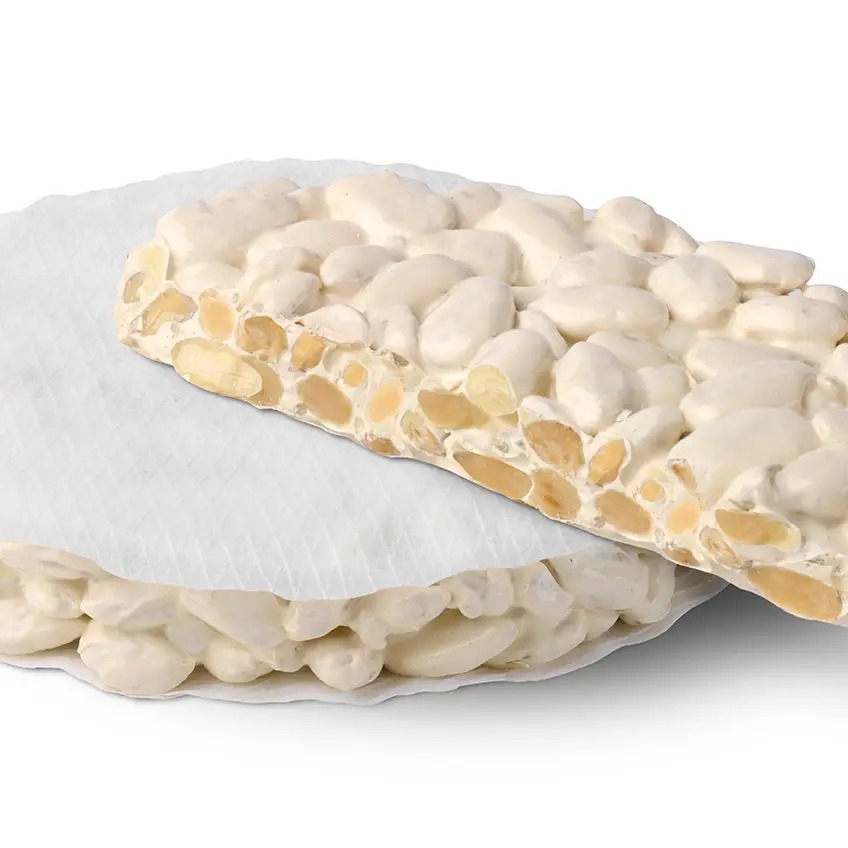
The paste is the same as that of hard turrón, but spread out into a thin round. It is not sliced; it is broken into shards, a little like a tuile. This is the case with the Castillo de Jijona torta, which weighs 200 g.
Imperial
The word is mostly seen on boxes of hard turrón, often next to torta. It does not tell the whole story on its own: the format and the list of ingredients tell you more. If you read “torta imperial”, expect something crunchy.
Oblea (wafer paper)
This is the thin white sheet that covers the top and bottom of hard turrón. It stops the paste from sticking and it is edible. On the Castillo de Jijona torta, it is made from potato starch and sunflower oil.
Figuritas (figurines)
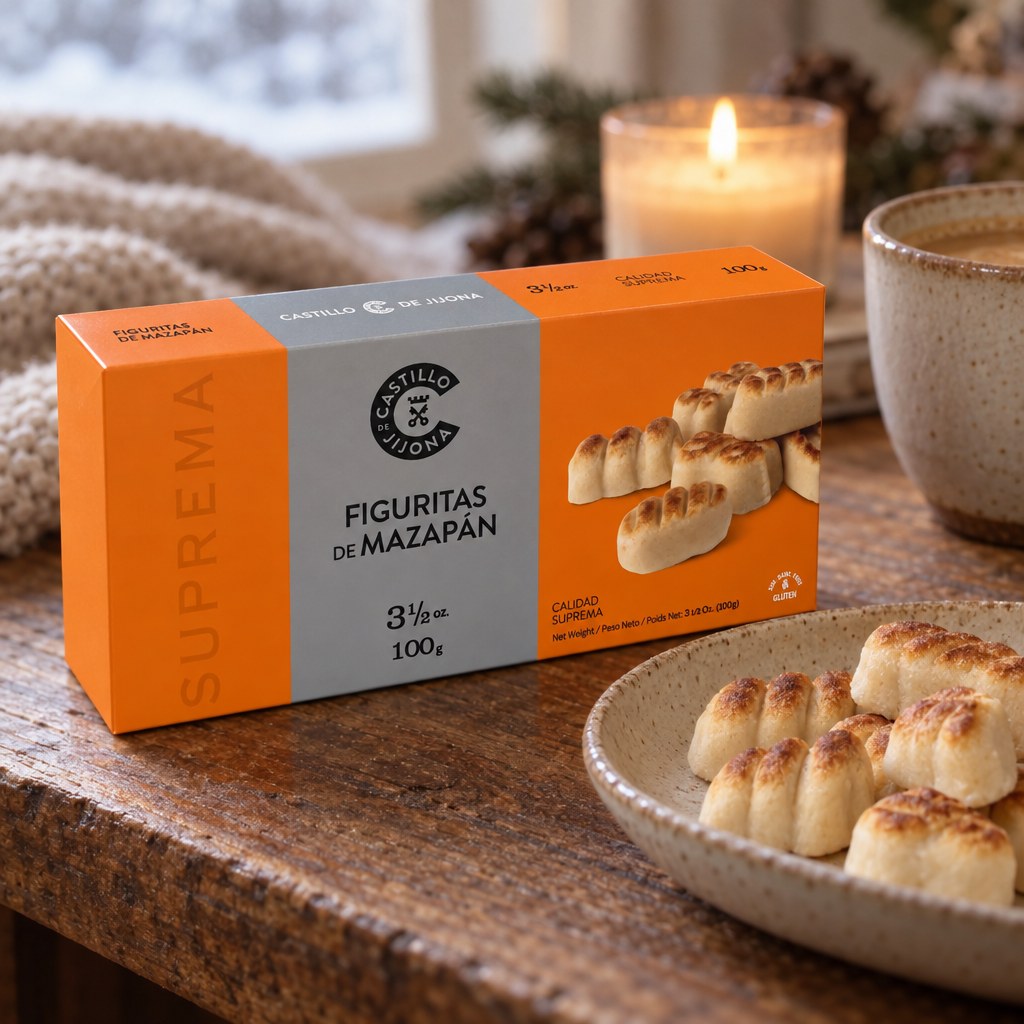
These are small pieces of marzipan, moulded one by one. In Spain, they are a Christmas sweet for festive tables, set out in a small dish.
The pastes: from crunchy to melting
Turrón duro
This is Alicante turrón: whole almonds, honey, sugar and egg white, cooked until the paste turns brittle. You can hear it crunch under the tooth.
Turrón blando
This is Jijona turrón: toasted almonds are ground to a paste, then worked with honey. The result is soft, slightly oily to the touch, and it melts slowly.
Yema tostada
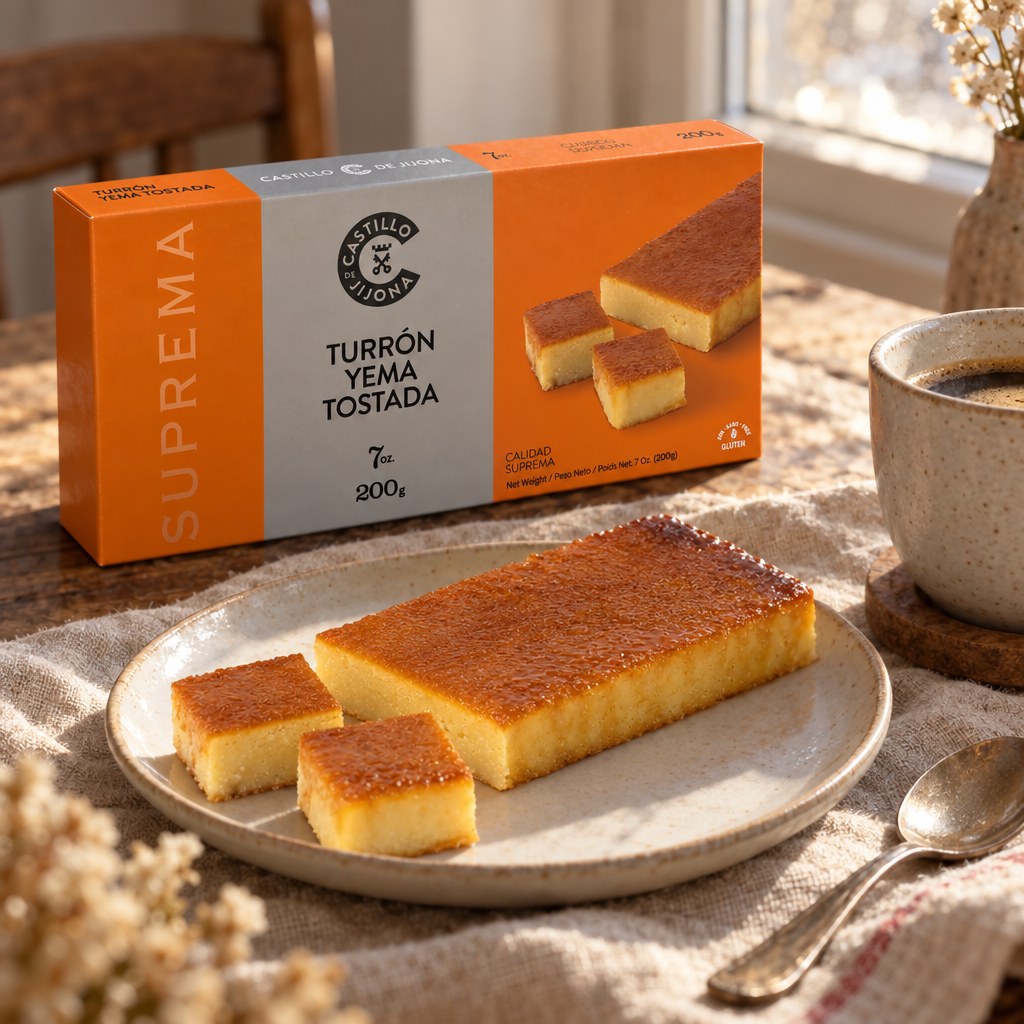
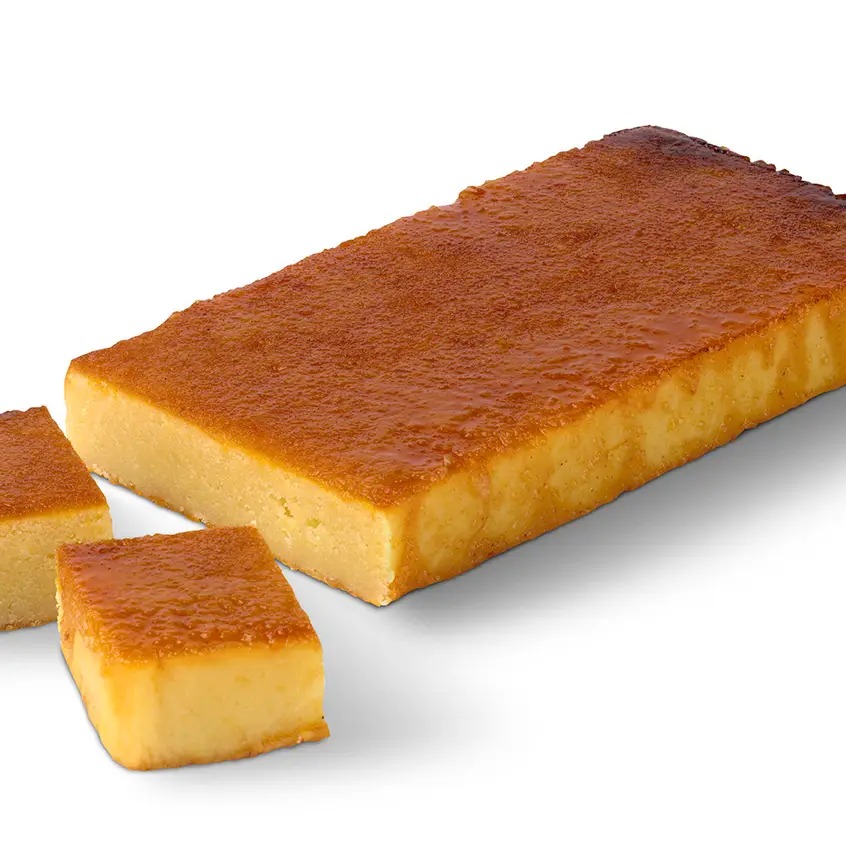
This is an almond paste made with candied egg yolk, its top caramelised like a crème brûlée. The Castillo de Jijona yema tostada combines 40% almonds and 23% candied egg yolk.
Yema confitada (candied yolk)
This is egg yolk cooked with sugar until it becomes a thick cream. It is what gives the yema its golden colour and its flan-like flavour.
Tostada (caramelised)
The word indicates that the top is caramelised, like a crème brûlée. It forms a thin amber crust that answers the sweetness of the paste.
Mazapán (marzipan)
This is the simplest of all: almonds and sugar, worked into a firm, dense paste. The Castillo de Jijona marzipan figurines contain 45% almonds.
Four pastes
One texture and one move for each
What the label says, how to cut, when to serve.
What you read in the list of ingredients
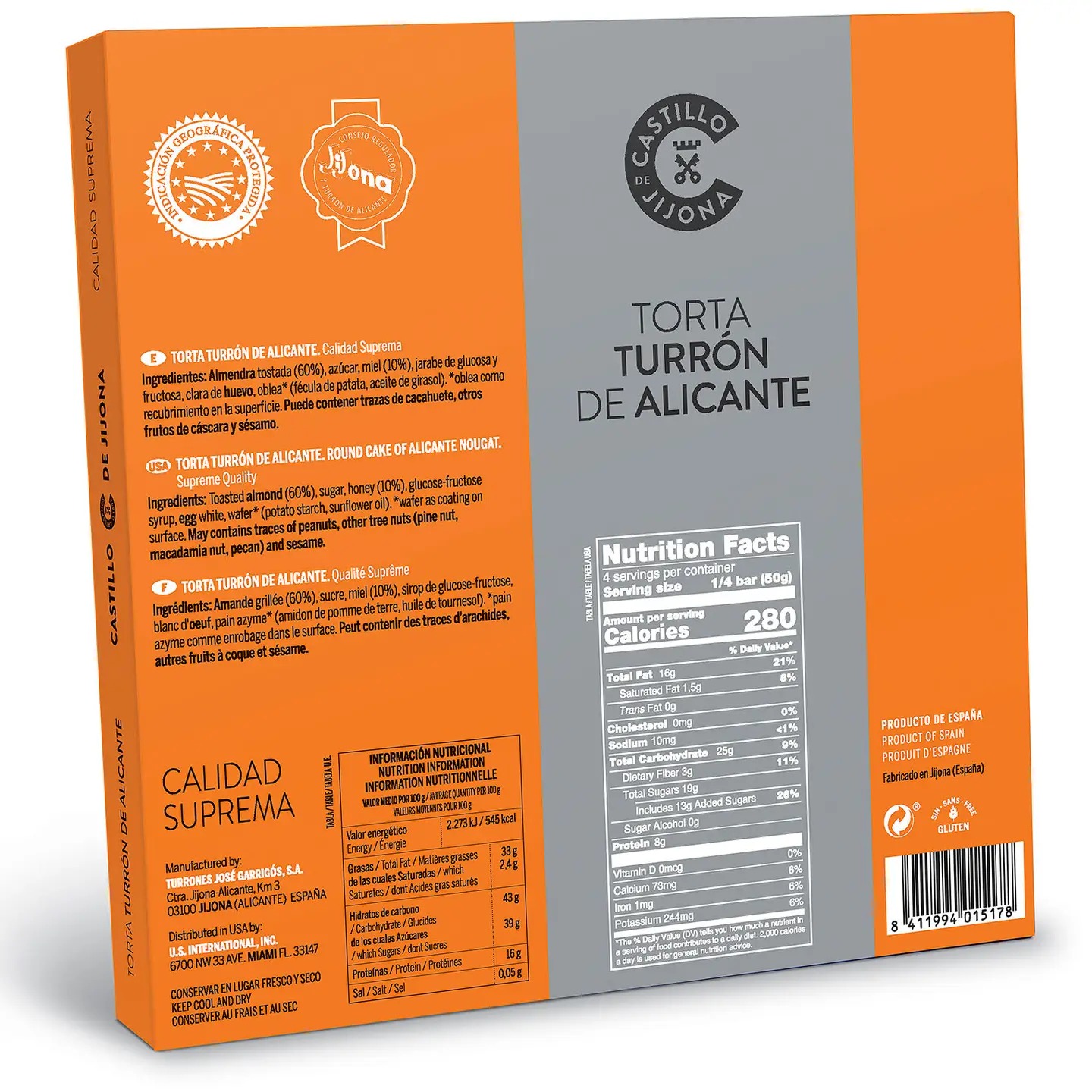
- Almendra tostada (toasted almond): this is what gives the flavour. Its percentage appears in the list: 60% in the torta, 69% in the Plaza del Sol Jijona.
- Miel (honey): it binds the paste and gives it its fragrance. The torta contains 10%, the Plaza del Sol Jijona 12%.
- Clara de huevo (egg white): whisked, then cooked with the honey, it gives hard turrón its structure and its snap.
- Allergens: all of these turrones contain almonds. The torta, the yema and the Jijona also contain egg, and the yema contains milk. Statements about traces are on each label.
To choose, look first at the percentage of almonds, then, for a Jijona or an Alicante, at the Regulatory Council seal.
In practice: cutting, serving, composing the table
How to cut each paste
- Torta: no knife. Lay it flat inside a clean tea towel and press down sharply with the palm of your hand. Serve the shards loose on a board.
- Jijona: use a thin blade, run under hot water and then dried. Cut thin slices, as the label advises.
- Yema tostada: cut thin slices, crust upwards, in a single movement so as not to break it. It is rich, so a small portion is enough.
- Marzipan: the figurines are served whole, in a small dish.
At what point in the meal
- At the end of the meal, with coffee: the Jijona in thin slices, then a few shards of torta for crunch.
- In place of dessert, or alongside it: the yema tostada, which links up with egg-based desserts.
- Later, on the coffee table: the marzipan figurines, which disappear all by themselves as the evening goes on.
A table with no repeated textures
With four pastes, you cover a wide range:
- crunch with the Alicante turrón torta;
- softness with the Jijona turrón IGP Suprema;
- caramelised creaminess with the yema tostada;
- density and melt-in-the-mouth richness with the marzipan figurines.
Mistakes to avoid
- Serving the turrón too cold: cold firms up the Jijona paste. Serve it at room temperature. For storage, follow the label: dry and away from heat for the Plaza del Sol Jijona, in a cool place for the marzipan.
- Slicing the torta with a knife: it breaks unevenly. It is made to be broken.
- Buying two bars with the same texture: two hard turrones, for example, make for a monotonous table. Think in terms of textures rather than brands.
- Cutting too thick: turrón is dense and sweet. Thin slices let you taste a bit of everything.
- Opening every box at once: open them as you go, and close the opened box properly.
Quick test
Can you read the label at a glance?
Five questions; the answers are in the article.