On a Spanish table at the end of a meal, there are often two bars side by side. One is white, bristling with almonds, and resists the knife. The other is beige, smooth, and almost gives way under the finger. These are the two great turróns, the Alicante and the Jijona. They start from the same ingredients, almonds, honey, sugar and egg white, but they have neither the same texture nor the same way of being served.
This guide teaches you to recognise them at a glance, to cut them cleanly and to serve them at the right moment. The last part is done label in hand: what a version with no added sugars changes, what stays the same, and how to adapt the tasting.
At first glance: the hard and the soft
Turrón de Alicante, the one that crunches
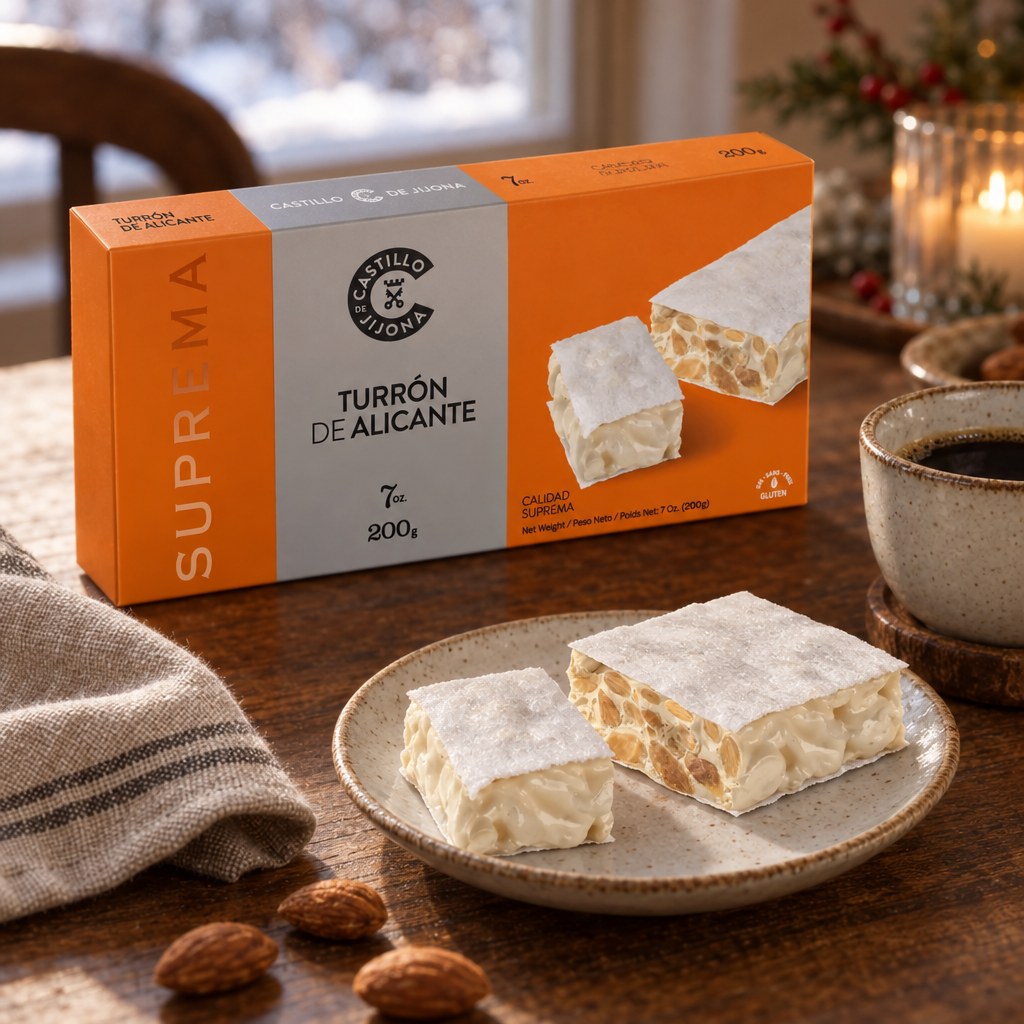
You recognise it by its whole toasted almonds, clearly visible, set in a pale mass of honey, sugar and egg white. A thin sheet of wafer paper covers it, that matt white paper which is edible. Under the knife, it does not cut: it splits, with a sharp snap.
Our Turrón de Alicante supreme quality from Castillo de Jijona contains 60% toasted almonds and 10% honey. The seal of the Regulatory Council of the Jijona and Turrón de Alicante PGIs appears on its packaging. Castillo de Jijona is a brand of Turrones José Garrigós, a house based in Jijona, the village of turrón.
Turrón de Jijona, the one that melts
Here, there are no more whole almonds. They are ground with the honey and the sugar until they form a soft paste, uniform and hazelnut-coloured. The knife goes in effortlessly, and the slice melts in the mouth rather than crunching.
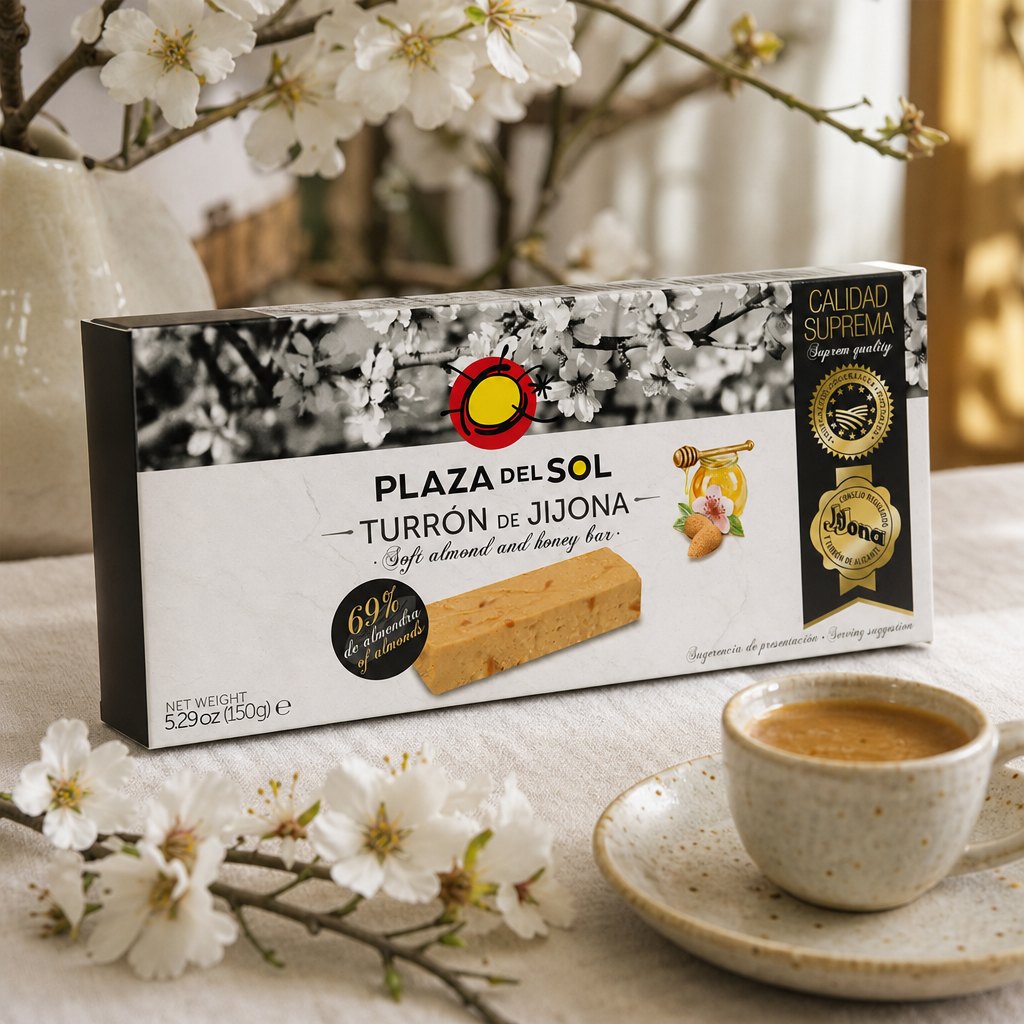
The Turrón de Jijona PGI supreme quality from Plaza del Sol is a good example: Jijona PGI, Suprema category, 69% toasted almonds and 12% honey. Plaza del Sol is an Alicante house, in San Vicente del Raspeig, dedicated to Spanish aperitif products.
To remember: if you can see the almond, it is the Alicante. If you taste it without seeing it, it is the Jijona.
Cutting without wrecking the bar
The hard one: thin slices or shards
Turrón de Alicante is handled like a slab of hard nougat. Two schools of thought, both right:
- In thin slices: place the bar wafer side up, take a large, heavy knife and press down firmly, in a single movement, rather than sawing. There is no need to cut thick.
- In shards: let it break as it pleases, into irregular pieces. It is less neat, but it is often how it is served en famille, in the centre of the table.
A blade barely warmed under hot water, then wiped dry, makes cutting easier.
The soft one: a thin, clean blade
The Jijona calls for the opposite: a thin knife, a slow cut, and a blade wiped between slices to keep the edges neat. Served at room temperature, it shows off its toasted almond better. Too cold, it stiffens and loses some of its melt.
The torta, which breaks like a tile
The torta is the round, thin version of hard turrón, from the same family as the Alicante. It is not cut: you break it by hand, like a tile, and everyone takes a piece. It is a turrón for sharing, the one you put in the middle of the table with the coffee.
Hard or soft
Four clues so you never mix them up
Tap a card: how to recognise it, how to cut it.
Serving: with a coffee, or to finish the meal
Turrón is not a plated dessert. It comes afterwards, when everyone is still at the table.
- With a coffee: a short, strong espresso or a cortado. The bitterness of the coffee answers the honey of the hard turrón and the melt of the soft.
- At the end of the meal: a small plate with a few slices of each, shards of Alicante on one side, slivers of Jijona on the other. Guests compare for themselves.
- With a glass: a sweet wine or a fortified wine goes well with the Jijona.
In the kitchen, the Jijona is happily crumbled over vanilla ice cream or melted into a custard; turrón is, incidentally, a classic ice cream flavour in Spain. The hard one is kept for crunching.
Allow little: a few thin slices per person. The almond flavour is intense, and that is what gives it its charm.
No added sugars: what the label says
Among the no-added-sugar turróns from Castillo de Jijona, we have selected two, one hard and one soft. The simplest way is to set the ingredient lists side by side.
The hard one: the imperial
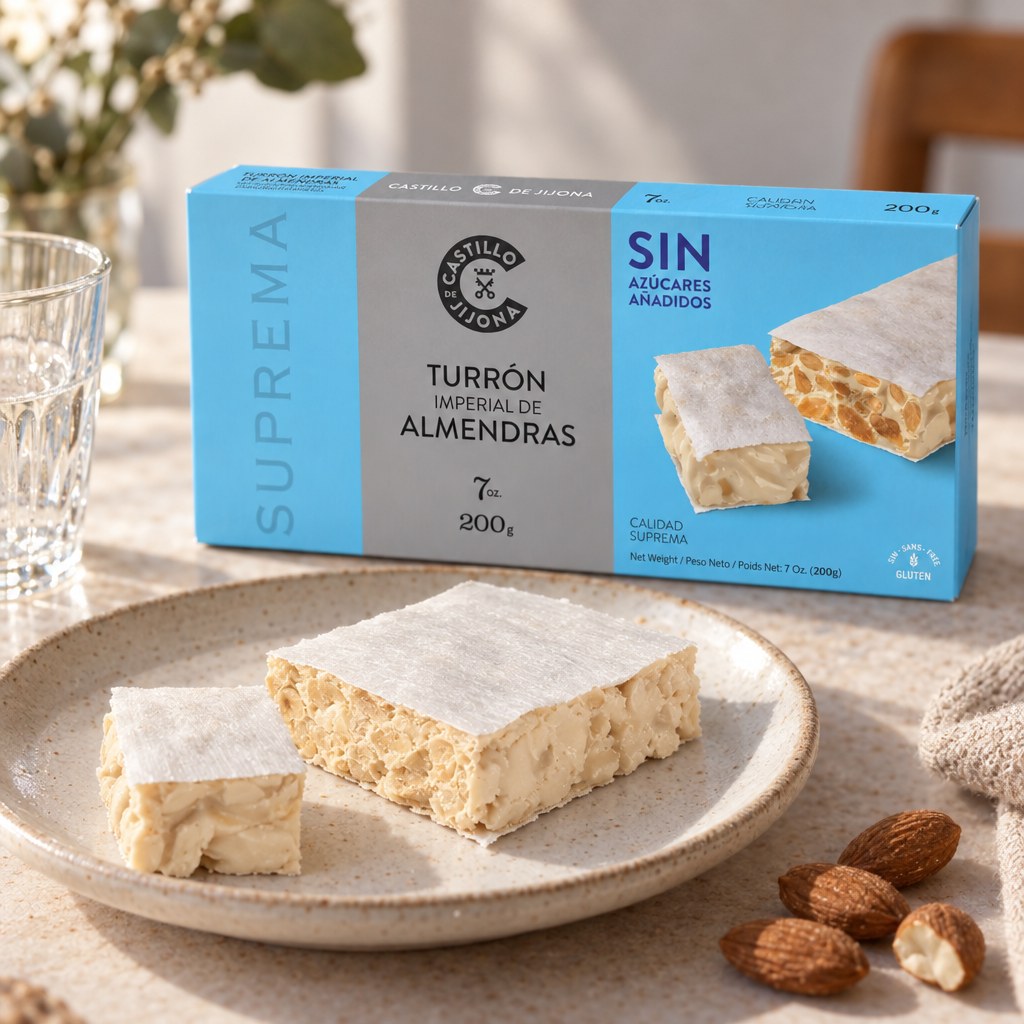
The Imperial turrón with almonds, no added sugars keeps the same share of toasted almonds as the Alicante: 60%, the egg white and the wafer paper. What disappears: the sugar, the honey and the glucose-fructose syrup. What replaces them: two sweeteners, isomalt and maltitol.
The soft one: the almond cream
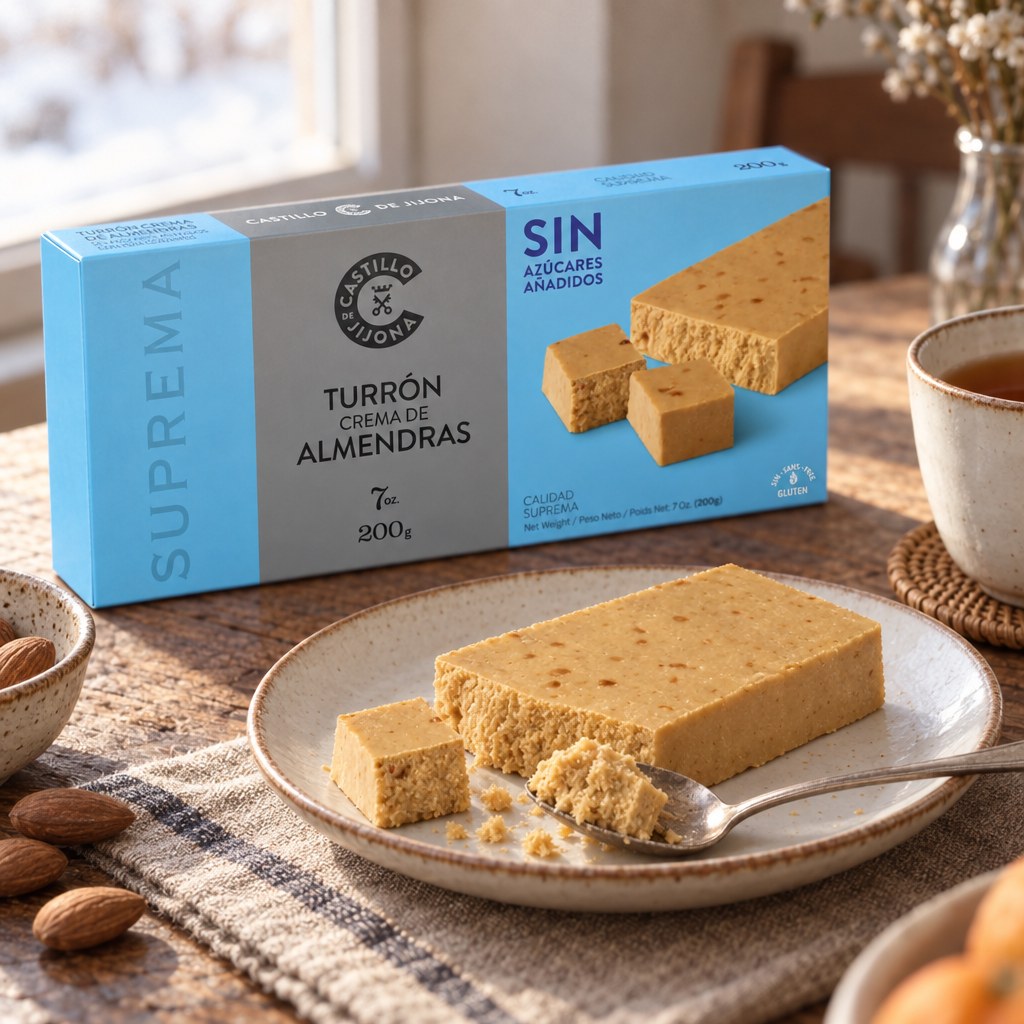
The Almond cream turrón, no added sugars goes up to 64% toasted almonds, with egg white and two sweeteners, maltitol syrup and sorbitol syrup. No honey either.
The statements to read
Both labels state ‘no added sugars, with sweeteners’ and ‘contains naturally occurring sugars’. They also carry the mandatory statement specific to these sweeteners. Both are gluten-free, like the Alicante, contain almonds and egg, and may contain traces of peanuts, other tree nuts and sesame.
What it changes in the mouth
The toasted almond remains central: 60% in the imperial as in the Alicante, 64% in the cream. What shifts is everything around it.
- The honey is no longer there. This is the clearest difference. The floral, slightly caramelised taste of honey gives way to a more neutral sweetness, and the toasted almond comes to the fore.
- The sweetness does not have the same depth. Sweeteners sweeten differently: a more discreet, more linear sweetness, without the roundness of sugar cooked with honey.
- The imperial remains a hard turrón. It is handled like the Alicante: a heavy blade, a clean movement. Isomalt, for its part, is a name pastry chefs know well, as it is used in sugar art.
- The cream remains a soft turrón. The slice melts in the mouth, with a frank almond flavour.
As for serving, treat them like the classic versions, playing on their more almond-forward character: a rather robust coffee, thin slices, and above all no blind comparison straight after an Alicante made with honey, which would overwhelm their more restrained sweetness. Served on their own, they find their place.
Label in hand
The two with no added sugars
What stays, what changes, and how to serve them.
In practice: what to choose, mistakes to avoid
What to put on the table
- To discover both styles: the Turrón de Alicante supreme quality and the Turrón de Jijona PGI from Plaza del Sol, served together.
- For a table where some avoid added sugar: the imperial for the crunch, the almond cream for the melt.
- For the pleasure of the almond: the almond cream, the richest in almonds of the four, after the Jijona.
Mistakes to avoid
- Sawing the hard turrón: it crumbles. One clean movement, a heavy blade.
- Serving the Jijona straight from the fridge: it loses its melt. Let it come back to room temperature.
- Removing the wafer paper: it is edible.
- Leaving the opened bar exposed to the air: the hard one softens in the damp, the soft one dries out. Reseal it well, and store it somewhere dry, away from heat.
- Cutting too thick: a thin slice is enough to tell the whole story of the almond.
Quick test
Hard, soft, or no added sugars?
Five questions; the answers are in the article.