Every year, as December approaches, the same questions come back. What exactly is a polvorón? Why does it fall to pieces at the first bite? Do you really have to press it before opening it? And, often too: what is in it?
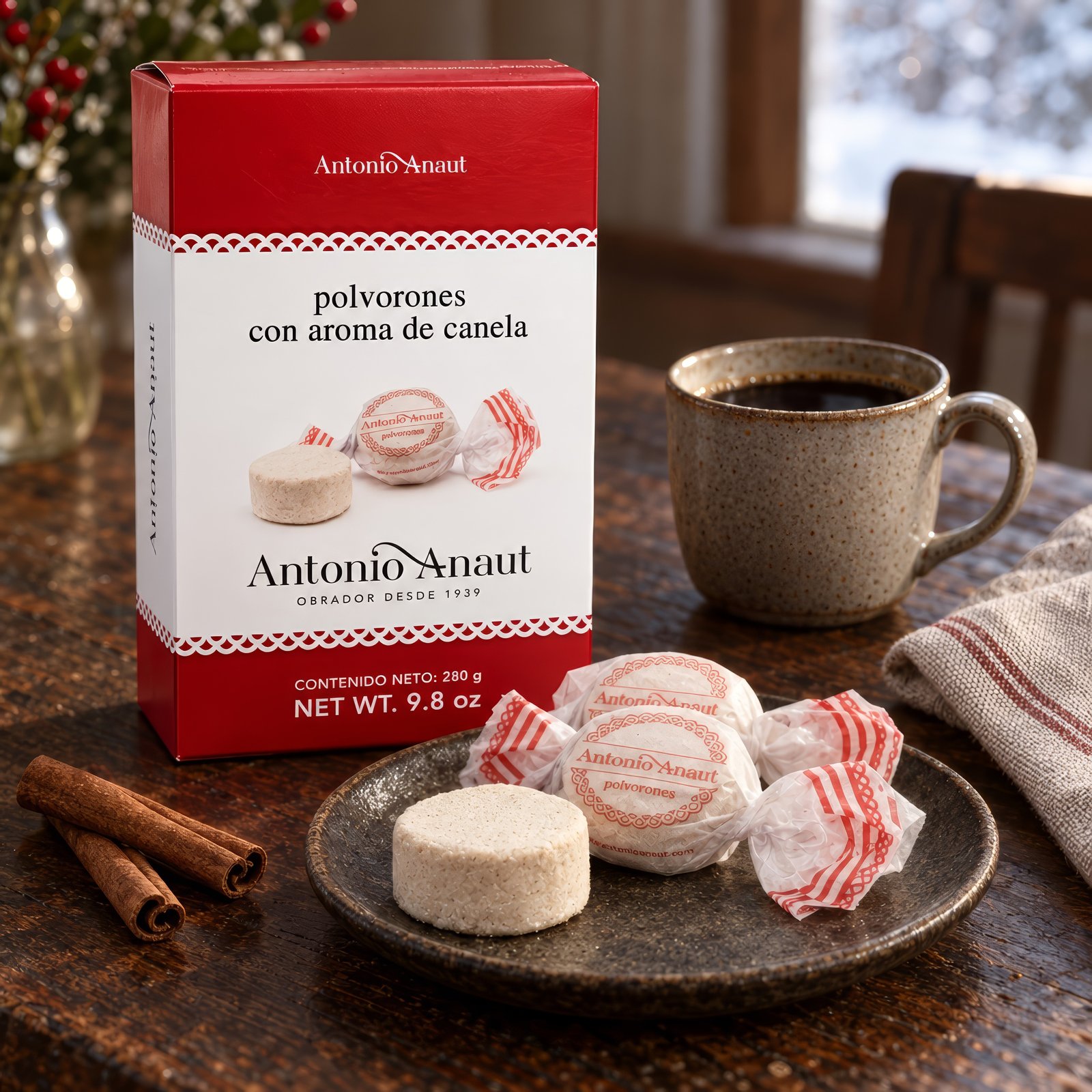
We have gathered our answers here, based on the polvorones we have chosen this year, those of Antonio Anaut, in Navarre. Three flavours: cinnamon, lemon, cocoa. Enough to know what to put on the table, and when.
What is a polvorón?
It is a small, round shortbread-style biscuit, typical of the end-of-year festivities in Spain. You find it on the Christmas table, among the turrones and the mazapán, often in a small dish from which everyone helps themselves. Its name comes from polvo, dust: it carries within it the way it is eaten.
It fits in the hand, it is pale or brown depending on the flavour, and these arrive wrapped one by one in tissue paper that you unwrap like a sweet. This little ritual is part of the pleasure.
The ones we offer come from Antonio Anaut, in Tafalla, in the heart of Navarre. On the packaging, a date: « Obrador desde 1939 ». The obrador was born in Pitillas and moved close by, to Tafalla, in 2016, without ever leaving the Zona Media of Navarre. The house carries the Reyno Gourmet seal, the quality mark for products from Navarre.
The vocabulary
Six words to understand the polvorón
Tap a word: what it means, and what it tells you about these polvorones.
Why does it crumble so much?
This is the most frequent question, and it is also what gives the polvorón its charm. A polvorón is not a failed biscuit: it is made to melt.
To understand, you only need to think like a cook. In a bread dough, water and kneading create an elastic network that holds everything together. Here, it is the opposite:
- The fat coats the flour. At Antonio Anaut, it is lard. It surrounds the flour and stops it from forming that elastic network.
- No egg to bind. The ingredients list published by the house does not include any: nothing sticks the particles together.
- No water either. Flour, sugar and fat: the dough stays sandy and dissolves in the mouth.
The result: a dough that only just holds together, long enough to get from hand to mouth. At the first contact with the teeth, it gives way. That is intentional.
How do you press it in its tissue paper?
It is a common gesture in Spain, and the one that saves you from scattering crumbs over the tablecloth. Before opening the paper, you press the polvorón to compact it a little.
- Keep it closed. Do not unwrap the tissue paper yet.
- Place it in the hollow of your hand and close your fingers over it.
- Press gently, without crushing. You feel the dough tighten under the paper.
- Open it like a sweet, then unfold the paper.
- Bite straight in, or break it in two over the paper, which serves as a plate.
Pressed this way, it keeps its shape a little longer, but it still melts in the mouth. If you open it without pressing, it will crumble more: nothing serious, just keep the paper to hand.
The tissue paper is not just packaging: it is the polvorón's plate. You eat over it, and the crumbs stay inside.
What is in it?
People often associate the polvorón with almonds. Those of Antonio Anaut declare none: according to the house, they are made of wheat flour, sugar and lard, to which the flavouring is added.
- Cinnamon: wheat flour, sugar, lard, cinnamon flavouring.
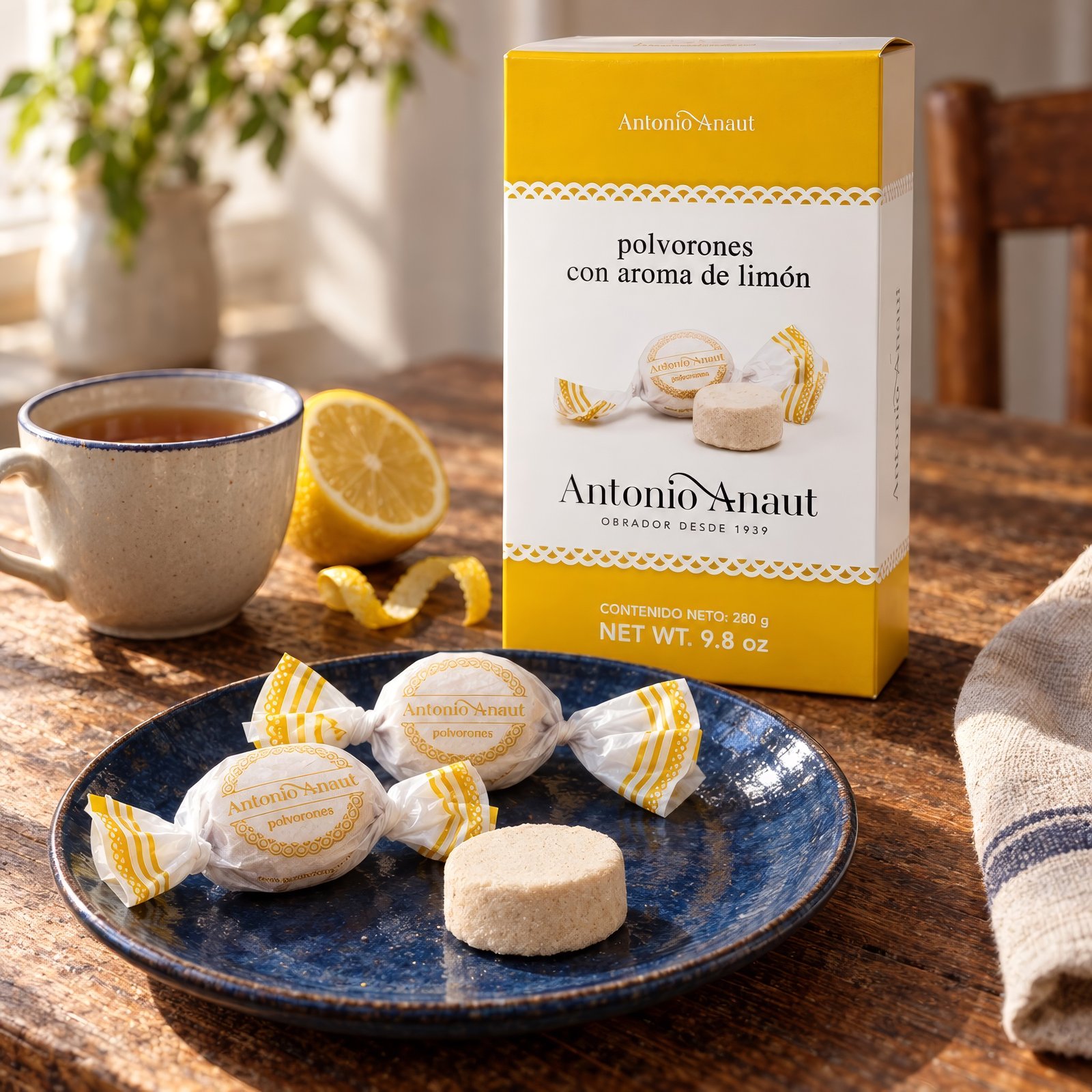
- Lemon: wheat flour, sugar, lard, natural lemon flavouring.
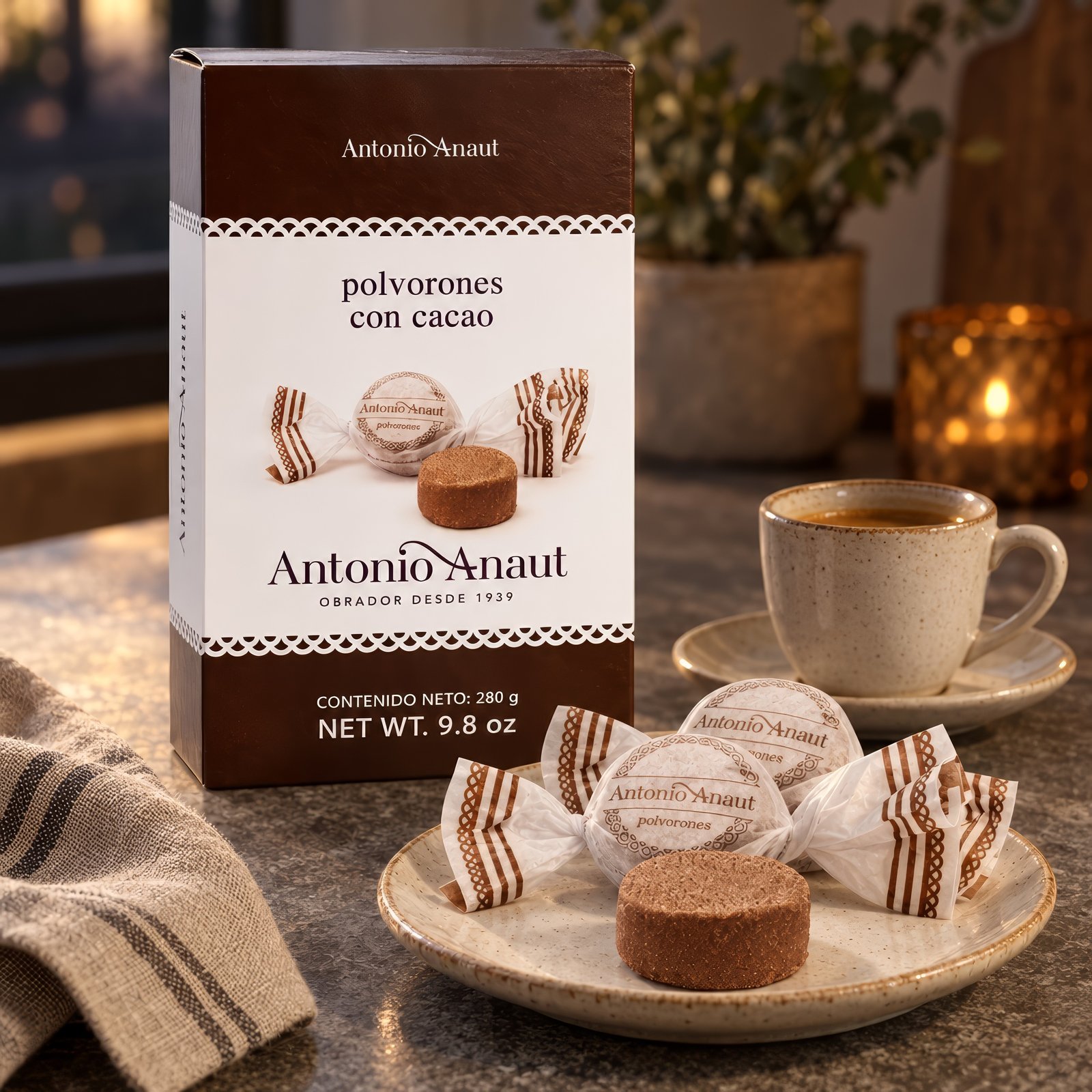
- Cocoa: wheat flour, sugar, lard, cocoa (3.5%), chocolate flavouring.
These lists are the ones the house publishes for its polvorones; the full list of ingredients and allergens appears on the label of each size, which is the authoritative source.
What to know before serving
- Neither vegetarian nor halal. Lard is pork fat. If you have guests who do not eat it, plan something else for them.
- Gluten. They contain wheat flour.
- Possible traces. The house states that they may contain traces of egg, soya and mustard. It describes them as free from milk and tree nuts.
Cinnamon, lemon or cocoa: how do you tell them apart?
All three share the same base and the same texture. It is the flavour, and the colour of the paper, that change.
Cinnamon: the classic
The cinnamon polvorón is the Christmas polvorón as it is put on the table in Spain. A pale shortbread, a warm, round spice. Tissue paper striped with red. If you only take one, take this one.
Lemon: the liveliest
The lemon polvorón is the liveliest of the three, with its natural lemon flavouring. Yellow packaging, paper striped with yellow. It appeals to those who find cinnamon too pronounced, and it wakes up the end of a rich meal.
Cocoa: the brown one
The cocoa polvorón is the brown one of the house, with 3.5% cocoa in the dough. Chocolate-coloured packaging, paper striped with brown. It is the one you unwrap at coffee time.
The colours of the papers have a practical advantage: in a mixed dish, everyone can spot their flavour without having to open anything.
When should you put them on the table?
In Spain, the polvorón is not served on a plate like a dessert. It arrives afterwards, with the rest of the Christmas sweets, and it stays there for hours.
- With coffee. This is its natural moment. A strong coffee or a milky one, and a polvorón alongside: the coffee rinses the mouth between sandy mouthfuls. Cocoa suits it particularly well.
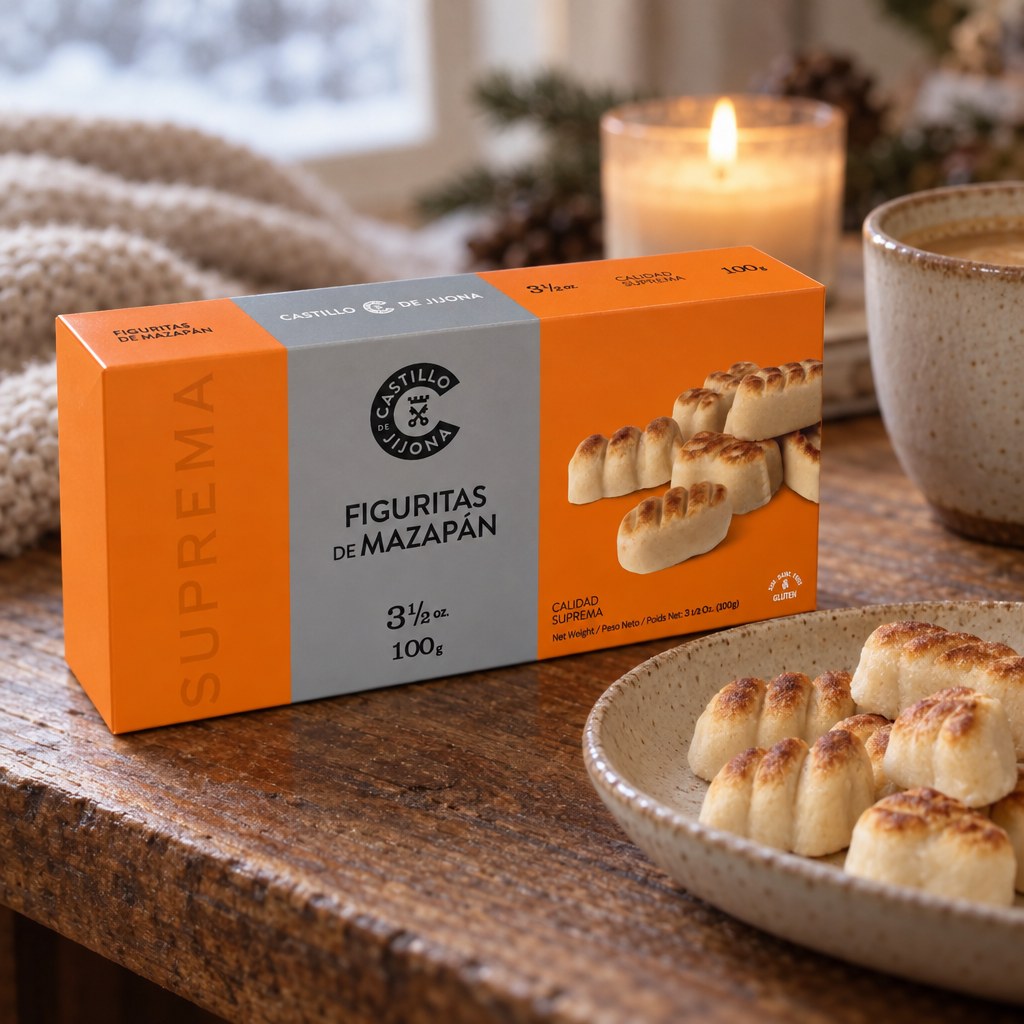
- Next to the mazapán figurines. The mazapán figurines from Castillo de Jijona, at 45% almond and moulded one by one, are the other Christmas treat of Spanish tables. A dish of each, side by side: the dense softness of the mazapán, then the crumbling texture of the polvorón.
- During long ends of meals. On the evening of the 24th, at lunchtime on the 25th, on the 31st: you leave them on the table and nibble as you chat.
- At afternoon tea in December. With a tea or a hot chocolate, throughout the month.
For drinks, keep it simple: coffee, tea, or a small glass of sweet wine for the adults. The polvorón is sweet and dry; it calls for something liquid.
On the table
Four moments to bring them out
The polvorón is not served on a plate. Here is when it arrives.
In practice: what to order and which mistakes to avoid
What to order
- For a first time: the cinnamon, the reference flavour.
- For a family table: all three flavours, mixed in one dish. The coloured papers do the rest.
- For a complete Spanish table: add the mazapán figurines (100 g).
All three flavours are offered in a 280 g size, currently on pre-order. We have few: when they are gone, they are gone.
Mistakes to avoid
- Opening without pressing. Not dramatic, but you will be picking up crumbs everywhere.
- Storing them near a heat source. Lard does not like heat. Keep them somewhere cool and dry, away from the oven and the radiator.
- Serving them to guests who do not eat pork without warning them. Lard cannot be seen; you have to say so.
- Presenting them as almond polvorones. These declare none. The mazapán, on the other hand, is almond-based: bear it in mind if someone is allergic.
- Transporting them loose. To take them to someone's house, leave them in their original packaging, packed tightly.
One last tip: put one in the pocket of your coat before the walk on Christmas afternoon. Pressed in the hand, opened outdoors, eaten while walking. That is how they are loved, too.
Quick test
Ready for the Christmas dish?
Five questions; the answers are in the article.